4 jul 2017

9 mar 2017
24 feb 2017
Elena Mendoza, 'La Ciudad de las Mentiras'. Teatro Real (21-02-2017)
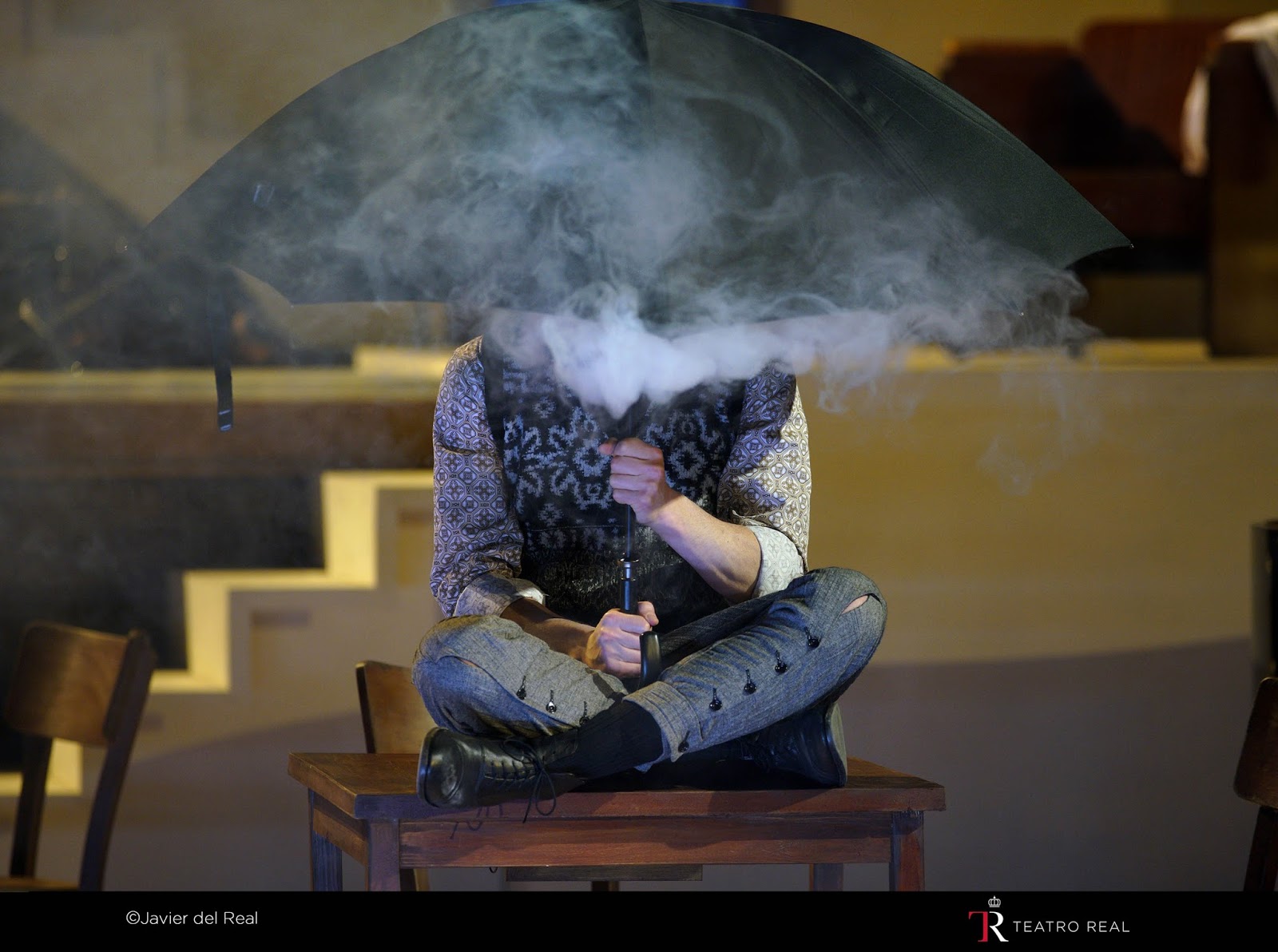
Es posible que la ópera o teatro musical de Elena Mendoza y
Matthias Rebstock que el Teatro Real de Madrid ha presentado en cinco funciones
este mes de febrero tenga un único problema, y está en el planteamiento inicial
de sus creadores: “Componer una ópera hoy en día significa hasta cierto punto
reinventársela como género”. Un artista siempre ha de jugar con premisas
ambiciosas, pero quizá nos hemos pasado de frenada. Una vez contemplada –y a falta de posteriores audiciones en la grabación que de
ella dispondrá en breve Radio Clásica de Radio Nacional de España- podemos
afirmar que esta ópera se inserta de forma natural en la tradición –sí, en la
tradición- del teatro musical germano de vanguardia. Las fuentes son
reconocibles, quizá en exceso; desde luego Mauricio Kagel, claro, pero también
Beat Furrer, Dieter Schnebel, Nicolaus A. Huber y una cierta impronta sciarriniana.
Mendoza ha empaquetado una propuesta radicalmente compleja,
abstracta; hábilmente enrevesada (y sagazmente desenmarañable); en la que
gozosamente no se ha doblegado ante la imponente tradición lírica del Real,
como tampoco lo ha hecho ante su conservador y reaccionario público. Nos
aventuraremos a la cábala: Gerard Mortier estaría orgulloso del fruto de su
encargo; y nos encantaría oír al fascinante gestor defender esta creación. Sin
embargo, esta Ciudad de las Mentiras tiene su principal debe en el muy
deficiente uso que hace del continente que se le ha brindado. Menos de 30
músicos (entre los repartidos por el foso, el escenario y el Palco Real) y una
amplificación que, inexplicablemente, resultó a todas luces insuficiente, lo
que es sorprendente teniendo en cuenta que esta corría a cargo del SWR
Experimentalstudio. Ahora pensamos que, con estos mimbres, la propuesta hubiera
funcionado mejor en un espacio como el Teatro de la Zarzuela. En el foso, el especialista
Titus Engel insuflaba toda la garra posible a una orquestación que solo adquiría
fuerza en los formidables interludios instrumentales, pero que se demostraba
insuficiente durante el transcurso de la acción. Tampoco funcionó la
espacialización, salvo en muy contados instantes, con lo que la intención de
hacer del teatro una caja de resonancia orquestal también falló.

Sea como fuere, estamos ante un trabajo de autor, porque la
voz de Mendoza, por más que beba indisimuladamente de las fuentes que
legítimamente ha elegido como suyas, adquiere tonalidades propias; en su
desprejuiciado uso del humor; en su fascinación por los juegos de percusión, en
la férrea atonalidad o en el uso de una gramática vocal que empieza a serle
propia. Porque una de las mayores grandezas de esta Ciudad de las Mentiras es,
precisamente y en contra del juicio mayoritario, el uso de la voz. Una voz que
rehúye el canto postexpresionista y que se recrea en la declamación, en el
continuo de voces y de sonidos que operan como sugestiva amalgama, en el canto
musitado, en el arrullo… La obra literaria de Juan Carlos Onetti que anima la
creación la descubrimos entonces como un idóneo vehículo para este despliegue
de sustanciosa vocalidad –sí, no exactamente operística, da igual-.
Destacaremos, desde luego, la aportación del actor Graham Valentine, como el
doctor Díaz Grey, con parlatos alucinados, de inquietante, vitriólica
musicalidad; y con algunos de los momentos de mayor sustancia emocional; como
sus vocalizaciones dirigidas al arpa del piano, creando sobrecogedoras
resonancias y dibujando momentos de figuración casi vampírica. El
percusionista-camarero Tobias Dutschke –con uno de los instantes más
hilarantes- y la soprano Laia Falcón sobresalen en un elenco absolutamente
creyente, entregado y valioso.

La escenografía estática de Bettina Meyer cubrió bien el
papel; pese a una figuración un tanto mejorable; con una caracterización, en el
caso del papel de Carmen –la acordeonista Anne Landa- que remitía al trillado
universo de la comedia dell’arte; o en la cierta sobreactuación teatral de
Guillermo Anzorena, como el gestor Langman; por lo demás uno de los cantantes
más sobresalientes del repertorio contemporáneo, como viene demostrando con su
desempeño en los Neue Vocalsolisten Stuttgart. Y, como en las óperas Aura, de José María Sánchez-Verdú,
sobre un texto de Carlos Fuentes o Murmullos del Páramo, de Julio Estrada, a
partir de la novela de Juan Rulfo (y ambas vistas en Madrid), el realismo mágico, tan caro a la literatura
iberoamericana, vuelve a seducirnos en estos relatos de Onetti que parecen querer burlar inútilmente a la parca. La Ciudad de las Mentiras es, en fin, una
creación exploratoria, considerablemente satisfactoria; y una apuesta de
capital importancia para que un teatro como el Real pueda seguir capitaneando la actividad lírica española.
11 feb 2017
Yaron Deutsch: "With all that surrounds us it's hard to block out the domination of popular culture on our life"
 |
| Yaron Deutsch. |
[On the occasion of the publication of the album Pierlugi Billone: Sgorgo Y . N . oO (Kairos)]
What and how was your first approach to Pierluigi Billone's music?
I very much remember hearing Mani. De Leonardis in Darmstadt as the first work I came in touch with by Mr. Billone. From that and from the moment circumstances brought us in closer contact I naturally got more and more familiar with the vast pallet of his work and warmly recall Quattro Alberi, ITI KE MI, Mani.Giacometti and Mani.Mono to resonate in me strongly. Although I believe to be able of putting in words how I approached his music I still preffer to recall a feeling I came accross with many times during the process of working on the piece. It was a feeling quite similar to the sensation of getting in touch with a new friend where you seem to have a none spoken understanding and sensitivity to things. In our case, a strong affection to the most minimal phenomenas the sound is consisiting of. Once embracing this approach and sensitivity, the path, to my humble opion, is extremely clear and in a sense, almost classical.
What are the main difficulties of a cycle like Sgorgo?
There are various layers to tackle for properly answering this question. First the works are no less acoustically challenging than they are electronically demanding so before (or following) the construction of the electric signal path (The "electronic" asspect of the sound), awaits the performer a microscopic handling of an extremely rich verity of physical execution parameters - slow or fast - that apply eventually to all four limbs. Parameters such as finger pressure, timbre and manner of attack, playing dynamics, articulation and additional body-instrument-machine actions (For example: regulating with your legs the pitches) are pivotal to the resulting sound succeeding the effects/electronic chain. The relations are eventually so that a non controlled physical action can easily result a completely different outcome then required in the score.
Secondly, a great challenge was to find a way for coming to a convincing sound (to my ears) that will further compliment the sound vision of Mr. Billone. In general for every piece I play and the Sgorgo cycle is no different, I take extreme care of the developped sound which is obviously a result of the physical asspect of playing but also requires a visionary handling of machinary and accordingly keeping them both in symbiotic relations.
In these pieces not only that the sound manipulation gives an added definition to the works, they sometimes become critical to "amplifying" a succesful desired sonority. Once overcoming the above two, you are left with the obvious difficulties coming with the performance of a 75 minute tryptich.
Do you believe that the electric guitar already has its own literature in contemporary music?
Looking at the facts, Yes. There is literature and it is many times very electric guitar oriented. If it stands shoulder to shoulder with canonic literature of other more veteran instruments, obviously it is not. This is by the way fine and natural and it even might surprise you but I don't find this to be of a disadvantage. On the other hand, I am not a crusader of the electric guitar as there is anyways so much music to play on the instrument without having it defined as "literature".
Of what contemporary composer, live or not, would like to have a work for electric guitar?
Luigi Nono, Gerard Grisey and Karlheinz Stockhausen.
Do you think that it is difficult for the composer not to take into account the instrument's history rock / pop?
I imagine that with all that surrounds us it is hard to block out the domination of popular culture on our life. Since the composer is a person in society he/she are not amuned and accordingly, wanting it or not, the instrument's history has an impact on him/her. Still, once identified it is also quite possible I believe to reject these influences, at least to a crticial extent.
How would you define the profile of the Nikel Ensemble?
A quartet of four very different but complimentary people and artists, that sahre passion for performing music they believe to be potentially exciting and such that will challenge and expand their musicality and life experience.
What can you tell us about the tenth anniversary and the next publication (Nikel Box)?
This Nikel anniversary box is an object that will include 4 cd's - each with a specfic focus - and one dvd documenting a full live Nikel show joined by a medium size book (not booklet) hosting visuals, texts by various writers and additional inserts from the composers we've been working with and recording their pieces for this release. It is done with no label as part of our indie approach and as well for fulfilling our desire of oferring this objebr in a very accessible price for each who will desire.
Versión ampliada y en inglés de la entrevista publicada en el suplemento cultural 'Aladar' de El Correo de Andalucía el 11 de febrero de 2017.
Suscribirse a:
Entradas (Atom)